Karakuri Ball 6 - Squid Attacker
US/EU: Power Sphere 6 - Squid Drill
Zord Information
Toyline
Bandai Japan: Karakuri Ball 6 - Squid Attacker
Bandai US/EU: Power Sphere 6 - Squid Drill
Bandai US/EU: Power Sphere 6 - Squid Drill
Release (Japan)
-
Release (US/EU)
-
JAN Code (JP)
-
Mecha Type
Auxiliary
My version
-
Mecha Condition
-
Description
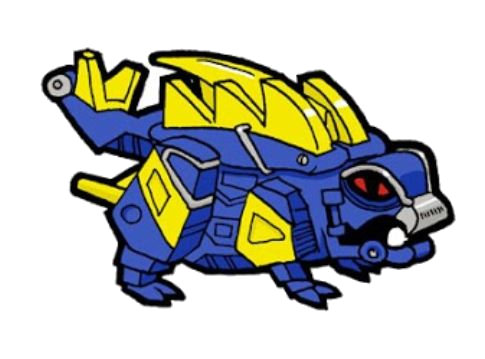
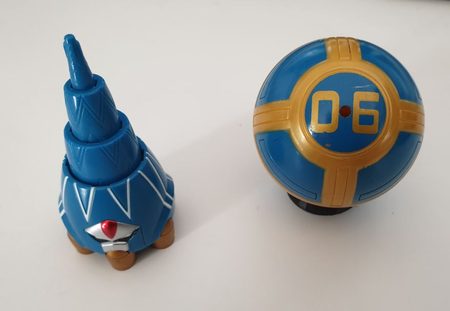
The Squid Attacker (イカアタッカー) is Karakuri Ball No. 6 from Ninpu Sentai Hurricaneger (2002) – not a standalone battle robot, but one of the handy weapon-and-support mecha that form the heart of the Hurricaneger mecha system. Slot one of the coin-like Shinobi Medals into a Karakuri Giant and the robot materialises, launching a ball from its chest; the ball splits open to reveal the Karakuri weapon stored inside – in this case the squid-shaped Squid Attacker.
In action the Squid Attacker mounts on Senpuujin's right knee to deliver its piercing finisher, the "Spindle Drill" – a boring knee strike that drives the giant straight through its opponent. A genuine collector's treat: it also docks with Karakuri Ball No. 5, the Gatling Leo, to form the combined "Gatling Attacker" weapon – a perfect example of the modular, mix-and-match ethos of the Karakuri Ball line, where the little spheres combine freely with one another and with the big robots.
In Power Rangers Ninja Storm the piece is called the "Squid Drill" and belongs to the Power Spheres line. Curiously, it is the only Power Sphere never named on-screen – its name comes solely from the toyline. On the Storm Megazord it serves the same piercing knee-strike finisher and pairs with the Lion Laser to form a drilling turbine combination weapon.
As a toy, the Squid Attacker was released in Japan by Bandai as part of the "Karakuri Ball Series" – small, openable spheres designed as accessories for the DX Senpuujin; in the US, Bandai America marketed the same pieces as "Power Spheres." For collectors, complete Karakuri Ball sets are prized display additions today, precisely because the tiny loose spheres were so easy to lose and individual numbers can be hard to track down in complete condition.