Tensou Henkei Gosei Ultima
US/EU: Gosei Ultimate Megazord
Zord Information
Toyline
Bandai Japan: Tensou Henkei Gosei Ultima
Bandai US/EU: Gosei Ultimate Megazord
Bandai US/EU: Gosei Ultimate Megazord
Release (Japan)
09/2010
Release (US/EU)
09/2013No. 35097
JAN Code (JP)
4543112626288
Mecha Type
Supporter
My version
Bandai US/EU
Mecha Condition
Used, no original packaging
Description
Gosei Ultimate is the final and largest mecha unit from Tensou Sentai Goseiger (2010), the Japanese source series for Power Rangers Megaforce (2013). It is deployed by the five-member Goseiger team (the "Gosei Angels": Gosei Red, Pink, Black, Yellow and Blue) together with their ally Gosei Knight. Unlike the animal-based Gosei Machines, Gosei Ultimate is not an animal combination but a self-contained giant unit, drawn from the powers of the five Miracle Gosei Headders and the cornerstone of the second Heaven's Tower. In the US adaptation it is known as the Gosei Ultimate Megazord. The title "Tensou Henkei Gosei Ultima" used in the request refers to this same unit; the correct name is Gosei Ultimate, and as a combining toy it was marketed under the "Tensou Gattai" (transfer-combination) toyline rather than "Tensou Henkei."
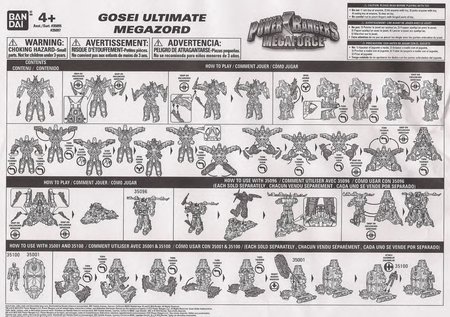
Mechanically, Gosei Ultimate has two modes: a flying "Machine Mode" that doubles as a command ship, and an upright "Robo Mode." It is armed with twin Ultimate Swords and five energy cannons concealed behind the five Miracle Gosei Headder faces on its chest. Its most notable feature is compatibility with the separately sold Gosei Great: Gosei Great latches onto the underside and uses Gosei Ultimate as a propulsion/jetpack unit, forming the combination called Ultimate Gosei Great (Ultra Gosei Great Megazord in the US toyline). That combined form appeared only on packaging and in commercials and was never used as a regular battle form in the Japanese series or in Power Rangers.
The DX toy was released in 2010 by Bandai Japan under the official name "Tensou Gattai DX Gosei Ultimate." It converts between Machine Mode and Robo Mode, carries the five Gosei Headders on its chest, and ships with a Gosei Card and Japanese instructions; connecting it to an existing DX Gosei Great produces Ultimate Gosei Great. Construction is predominantly ABS plastic — the Goseiger line markedly reduced die-cast content compared with earlier Sentai series, so a high metal content should not be assumed here. The US counterpart was sold as the "Gosei Ultimate Megazord" through Bandai America as part of Power Rangers Megaforce, and was scaled down and made more affordable than the Japanese release.
Manual & Documentation
⚠️
Important legal notice: The copyrights of the shown or linked manuals belong to the respective license holder (e.g. Toei Company, Bandai, Hasbro). The display here is purely for non-commercial, documentary fan purposes.